
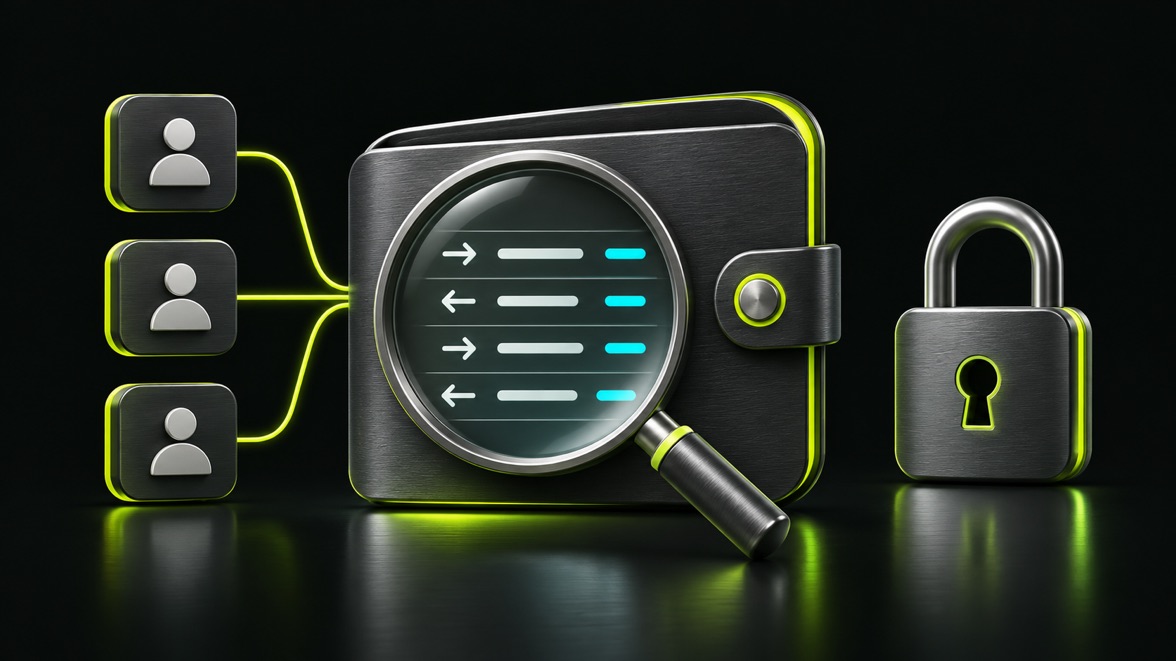
What can be viewed without wallet access
A TRON explorer shows public account activity, visible transfers, times and participants. For tokens, inspect the specific contract and its events rather than relying on a token label in the general history. A record named USDT does not establish that genuine USDT moved.
Current resources and account-permission configuration can also be queried. History, token balances and available Energy are different datasets and an explorer may refresh them at different times. An old successful delegation is not proof that the resource is still available.
| Visible information | What it does not prove |
|---|---|
| Balances and transfers | Owner identity or all of their assets |
| A platform label | That the details suit your payment |
| Permission configuration | That the person sharing the address can sign |
| Past Energy delegation | That the resource is unspent and unexpired |
Can an address reveal a name, phone number or IP?
An ordinary transfer record does not contain a passport, phone number or client IP. Identity links often come from outside the chain: a public profile, published invoice, conversation or platform-held customer information. An explorer label is not independent identity verification.
Consider a shop publishing the same receiving address on its checkout and social channel. An observer can associate that address with the shop and inspect activity. It does not follow that every receipt is revenue or every connected address belongs to the merchant. Those conclusions need additional context.
Why one balance is not someone’s net worth
A person can have multiple accounts, while one address may serve an organization or platform. An exchange deposit address’s balance need not equal the customer’s internal account balance: custodial systems maintain their own ledgers and move funds between addresses.
Do not add every incoming transfer as income or classify every outgoing payment as a purchase. Refunds, internal movements, operational payments and spam can all appear. To assess a particular payment, establish its contract, amount, direction, time and purpose with the parties involved.
Does knowing the address allow someone to steal USDT?
An address is not a signing secret. Authority comes from the relevant keys and current account permissions, or a contract’s access rules. Looking up an address or importing it into watch-only mode does not create spending rights.
Public activity can nevertheless support social engineering. Fake support may quote a real TXID, and a lookalike may appear alongside normal payments. Knowing an amount or transaction history does not authenticate a support agent. Never provide a recovery phrase, private key or login code to that person.
What to share with support
A transfer investigation normally needs the chain, TXID, public address, amount, time and request number. For EZ Energy, include the order number and resource destination. Use the official support channel rather than trusting an unsolicited private message.
Even public records can link an account to your identity when posted under your name. Remove unnecessary emails, phone numbers, other balances and account identifiers from public screenshots. Use the platform’s established identity-verification process, not a document-upload or signature link supplied by a stranger.
- Share public transaction details with an appropriate privacy context.
- Never send seeds, private keys, passwords or API keys for a routine lookup.
- An entire account screenshot often reveals more than one question requires.
Use address tools without assuming guarantees
A resource calculator and AML screening answer different questions. One estimates resources for an operation; the other searches available risk indicators. Neither establishes a seller’s identity or guarantees exchange credit.
Verify fresh receiving instructions, the network and the recipient’s rules before paying. For rental, use your activated sending address. Public analysis and incoming resource delegation do not require surrendering keys. Visibility of records is not authorization to spend tokens.
FAQ
Is it safe to share an address for Energy delivery?
Delegation needs a public address, not a key. Its on-chain activity is visible, so consider who receives it and the identity context.
Can someone see all my wallets?
Not automatically. Activity and external information can suggest links, but a connection alone does not prove common ownership.
Does the address reveal my wallet password?
No. It does not disclose the application’s local password or recovery phrase.
Does a new address erase old records?
No. Old records remain and later transfers can create visible links. A new address is not an anonymity guarantee.
Sources
Technical facts are checked against official TRON documentation. Resource use can change with network and contract state.
TRON accounts and keys ↗TRON wallets and signatures ↗TRON account permissions ↗TRON resource queries ↗Ledger: wallet tracking and identity ↗